
BRICS nations have successfully reached a consensus on a joint statement following extensive negotiations, with India playing a crucial role in bridging differences, particularly among West Asian members like Iran, Saudi Arabia, and the UAE, despite regional conflicts and geopolitical tensions.

Union Minister Shivraj Singh Chouhan informed the Lok Sabha that government initiatives in the agriculture sector have doubled farmers' income through measures like MSP and fertiliser subsidies.

One of the important topics of discussion between the two leaders is expected to be the Northern Sea Route and the Chennai-Vladivostok Maritime Corridor.

Tamil Nadu Chief Minister C Joseph Vijay announced the withdrawal of police cases against farmers who protested against the Parandur airport and SIPCOT projects, and against teachers who protested for their rights. The decision, made on humanitarian and democratic grounds, aims to strengthen democratic rights and public trust in the government.
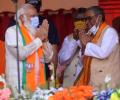
Ten days after the expansion of the BJP government's cabinet in West Bengal, key portfolios have been allocated, with senior leader Tapas Roy taking charge of industries and journalist-turned-politician Swapan Dasgupta appointed finance minister.

The BRICS summit in New Delhi brings together leaders from major emerging economies to address global challenges like trade disputes, geopolitical upheavals, and the economic impact of conflicts in Ukraine and West Asia. India, as chair, aims to position BRICS as an economic growth engine, focusing on the Global South's food, energy, and supply chain security. The summit also highlights the grouping's expansion and its growing influence in global governance.

The US-Canada trade war has escalated sharply, with US President Donald Trump on Monday announcing that tariffs on Canadian cars, trucks, automotive parts and steel imports will be raised to 50 percent from January 2027, following the collapse of trade negotiations between Washington and Ottawa last week.

Left parties have strongly condemned the government's decision to impose charges on UPI payments exceeding Rs 2,000, with CPI General Secretary D Raja alleging the move was made under "US pressure" to favour foreign payment companies. Both CPI and All India Forward Bloc demand the withdrawal of this "anti-people decision," arguing it burdens consumers and merchants while undermining UPI's role as a public digital infrastructure. They highlight concerns that the charges weaken India's digital sovereignty and serve commercial interests of foreign corporations like Visa and Mastercard.

Prime Minister Narendra Modi cautioned against the 'weaponisation' of technology and critical minerals at the BRICS summit, advocating for cooperation to foster shared prosperity. Concurrently, Chinese President Xi Jinping announced plans for an open-source AI ecosystem for BRICS nations, positioning Beijing as a key technology partner amid global AI competition.

Prime Minister Narendra Modi has introduced a 'Sapta Dhara' (seven-stream) reform framework, aiming to propel India into a developed nation by 2047. This comprehensive plan focuses on key sectors including manufacturing, agro-food processing, technology, logistics, defence, green and blue economy, and soft power, leveraging the nation's youth potential.

Maratha quota activist Manoj Jarange has accused the Maharashtra government of conspiring to kill him and suppress his agitation, following Mumbai police's denial of permission for his indefinite hunger strike from September 19. Jarange stated he would proceed with the march to Mumbai despite the ban.
The Indian government has introduced a 0.4% transaction fee on Unified Payments Interface (UPI) payments exceeding Rs 2,000 for merchants, effective October 15, marking the end of nearly six years of free service. Person-to-person transfers and small-value transactions below Rs 2,000 remain free. The new Merchant Discount Rate (MDR) is capped at Rs 300 for transactions above Rs 75,000, with differentiated rates for essential sectors and investments, and safeguards to prevent costs from being passed to consumers.

The Indian government has introduced a 0.4% Merchant Discount Rate (MDR) on UPI person-to-merchant (P2M) transactions exceeding Rs 2,000, effective October 15. This move ends nearly six years of fully free UPI payments, though person-to-person (P2P) transfers and small P2M payments remain free. The charges aim to bolster investment in UPI infrastructure, with specific exemptions and caps for essential sectors.

Tamil Nadu Chief Minister C Joseph Vijay opened the sluices of the Stanley Reservoir in Mettur on Tuesday for irrigation in the Cauvery delta districts.

For India, the goal is not simply to host another grand diplomatic gathering. It is to prove that a diverse coalition of emerging powers can still deliver.

Bangladesh-China and Bangladesh-US relations have evolved from reluctant engagement to increasingly consequential strategic partnerships.

Indian farmers staged a significant protest at the Shambhu border against a proposed India-US trade deal, fearing its detrimental effects on the domestic agricultural sector and demanding its immediate abandonment. They later ended their agitation after assurances from the Haryana Agriculture Minister regarding the release of detained farmers and a meeting with the Union Agriculture Minister.

Nepal has launched a diplomatic initiative to secure climate-related compensation from major greenhouse gas emitters, asserting that post-disaster assistance for recent deadly flash floods should be viewed as a moral and legal liability, not charity. Foreign Minister Shisir Khanal highlighted Nepal's disproportionate suffering from global warming despite negligible emissions, citing rapid glacier melt and extreme mountain disasters. The country has formally approached the Loss and Damage Fund board for urgent financial aid following a catastrophic flash flood in the Bhotekoshi river basin.

A group of 21 pilgrims from Tamil Nadu faced a terrifying ordeal during a pilgrimage to Mount Kailash when flash floods and mudslides struck Timure, Nepal. Despite being trapped in a raging torrent, a combination of miraculous coincidences, quick thinking, and the selfless heroism of a couple, Ratnakumar and Poonguzhali, ensured their survival. Indian and Tamil Nadu officials coordinated a swift rescue operation, bringing them safely back home.

Maharashtra Chief Minister Devendra Fadnavis announced a significant waiver of approximately Rs 48,000 crore in pending electricity dues for farmers, aiming to facilitate new agricultural power connections and support the state's agricultural sector.

Four student protesters in Ranchi, on hunger strike against alleged irregularities in recruitment examinations, are in stable condition at Sadar Hospital. Two state ministers, Irfan Ansari and Shilpi Neha Tirkey, visited the students, urging them to end their fast and assuring government intervention, while students continue to demand resolution for alleged exam scams.

Russia on Monday assured India of uninterrupted supply of energy and fertilisers amid disruption caused by the West Asia crisis, as External Affairs Minister S Jaishankar met President Vladimir Putin in Moscow and held talks with his key interlocutors.

The devastating floods in Nepal have brought back memories of two major disasters in Uttarakhand in recent years, the Rishiganga tragedy of February 2021 and the Dharali disaster of August 2025, which caused extensive loss of life and property and left thousands struggling to rebuild their lives.

Veteran politician Mirza Fakhrul Islam Alamgir has been sworn in as Bangladesh's 23rd President, following a contested parliamentary election that saw him defeat Colonel (retd) Oli Ahmed. Alamgir, a longtime secretary general of the ruling Bangladesh Nationalist Party (BNP), will serve a five-year term.

Mirza Fakhrul Islam Alamgir, secretary general of the ruling Bangladesh Nationalist Party (BNP) and a close ally of former premier Khaleda Zia, has been elected as Bangladesh's new President in the first contested poll for the post in 35 years.

'He wanted to know what products I'd brought along, so I showed him jackfruit flour, which research has linked to managing type 2 diabetes.' 'Then jackfruit seed flour, a strong source of protein that rural households have eaten for generations without it ever becoming a commercial product. I gave him ripe jackfruit chips too.'

Change of guard in some states and evolving El Nino dynamics are triggering fresh actions on raging water-sharing disputes in several states.

Nepali Prime Minister Balendra Shah held his first one-on-one meeting with Indian Ambassador Naveen Srivastava, signalling a shift towards direct diplomacy after previously preferring group interactions. The discussion focused on strengthening bilateral ties, development partnerships, and mutual interests between India and Nepal.

Chief ministers from southern states convened at the Southern Zonal Council meeting in Kovalam, where Karnataka CM DK Shivakumar advocated for the 1971 census as the basis for delimitation and a freeze on Lok Sabha seats, while also addressing the contentious Cauvery water and Mekedatu dam issues.

Bihar Chief Minister Samrat Choudhary has called upon ministers and legislators to extensively use digital technology and Artificial Intelligence (AI) for balanced development and improved public outreach. He highlighted the state government's existing use of AI in welfare programmes and project cost reduction, stressing its importance for Bihar's progress in the digital era.

Union Finance Minister Nirmala Sitharaman announced the government's plan to establish a high-powered committee to examine reforms for the banking sector, aligning it with the vision of a 'Viksit Bharat' (Developed India) and India's next phase of growth.

Prime Minister Narendra Modi, in his 80th Independence Day address, expressed strong confidence that India will achieve developed nation status by 2047, urging citizens to embrace big dreams and unwavering resolve to realise 'Viksit Bharat'. He highlighted India's economic transformation and significant growth in various sectors, including defence production, electronic manufacturing, and mobile phone production.

While intense protests were seen in Mandya and preventive detentions carried out at several places, life remained unaffected in major urban centres like Bengaluru and Mysuru.
Economists highlight that resolving domestic policy bottlenecks, particularly through land reforms and improving the ease of doing business, will be critical for Prime Minister Narendra Modi's 'next-generation reforms' and India's economic transformation towards its 'Viksit Bharat' vision for 2047.

Prime Minister Narendra Modi has called upon India's youth to dream big, assuring them of government support and resources, including a Rs 1 lakh crore Innovation Fund, to bolster the country's burgeoning startup ecosystem and drive its journey towards becoming a developed nation.

Prime Minister Narendra Modi and NDA leaders reviewed India's progress in international sports and significant growth in youth employment opportunities at their weekly parliamentary meeting.

Karnataka Chief Minister DK Shivakumar on Sunday asserted that his government was committed to protecting the interests of the state's farmers and people on the Cauvery issue, while appealing to organisations to withdraw the proposed state-wide bandh.

Congress leader Ramalinga Reddy has resigned from his ministerial position in the newly formed Shivakumar government in Karnataka, expressing strong displeasure over the portfolio allocated to him. He had sought the Bengaluru Development portfolio but was given Major and Medium Irrigation projects, leading to a significant setback for the new administration.

Why the industry's public position changed is difficult to say. What the developments did establish, though, is that ethanol-blended petrol has become one of the country's most politically and commercially sensitive policy issues.

'It is not because of the war in West Asia, which began on February 28.' 'Petroleum product prices are already going through the roof. They are bound to have a serious inflationary impact.' 'A country's leadership is tested in trying times. It is here that the current leadership is failing.'
